
Kyoto holds 1,463,723 residents on 827.83 km², and the way visitors spend money there is stranger than the guidebooks admit. Across the 50 experiences we sampled, a single departure — the PERFECT KYOTO 1-Day Bus Tour, €108.10 for 8 hours — collects 16,787 of the 56,810 reviews in that sample. One product, close to 30% of the recorded attention.
That concentration hides the more useful pattern. Once you convert each listing into an hourly rate, Kyoto stops behaving like a market where money buys quality. The spread is enormous, the ratings barely move, and the most expensive hour in the sample is also the best-rated one. Everything below is built on that arithmetic and on what the city's own institutions publish about their gates, their rules and their fares.
Why one Kyoto bus tour holds 29% of the reviews
Because it solves a geography problem. Kyoto's headline sights sit on opposite edges of the basin — Kinkaku-ji in the northwest, Kiyomizu-dera in the eastern hills, Fushimi Inari Taisha in the far south, Arashiyama in the west — and no single rail line strings them together.
The €108.10 full-day coach rates 4.92 and works out at €13.51 an hour. Beside it sits a near-twin at the identical price: the World Heritage Kyoto & Nara Uji Authentic Matcha Experience, also €108.10, running 8.5 hours at 4.94 across 2,444 reviews — €12.72 an hour. Same money, half an hour longer, a marginally higher rating, and it leaves the city entirely for the tea fields of Uji and the deer park of Nara. Two products priced to the cent alike, shaped completely differently. What sits on the Nara side of that day is on our Nara destination page.
Kyoto by the hour: €6.86 to €73.22, ratings 4.84 to 4.97
Divide price by duration and the Kyoto catalogue fans out over a factor of ten. The hourly rate — listing price divided by listed duration — is the only figure that makes a 90-minute workshop and an 8-hour coach day comparable, and it is the figure no listing prints.
At the bottom sits the Kyoto Traditional Kintsugi Workshop in Gion: €10.29 for 1.5 hours, €6.86 an hour, rated 4.92 across 1,654 reviews. Kintsugi is the repair of broken ceramics with lacquer and gold powder, so the seam becomes the ornament. At the top sits the Award-Winning Authentic Ramen Making Experience: €109.83 for 1.5 hours, €73.22 an hour — and joint-highest rating among the ten most-reviewed, at 4.97 across 2,590 reviews. Ten times the hourly rate, five hundredths of a rating point apart.
In Kyoto, price does not predict satisfaction — and the dearest hour is the best-reviewed. Across the ten most-reviewed products in our sample, the hourly rate spans €6.86 to €73.22 while every rating falls inside 4.84 to 4.97. Eight of the ten sit at 4.92 or above. Choose by what the hour contains, because the number attached to it carries almost no signal.
The middle of the range is where the choosing actually happens. The Ultimate Kyoto Arashiyama Tour runs €57.41 for 5 hours — €11.48 an hour at 4.97, the joint-highest rating in the sample and among the cheapest hours in it. The Kyoto Early Morning Tour with English Speaking Guide costs €69.67 for 5 hours, €13.93 an hour at 4.95. The Hidden Kyoto E-Biking tour asks €97.02 for 3.8 hours — €25.53 an hour, roughly double, for the same 4.95. Across the whole Kyoto catalogue we track 1,600 bookable experiences at a median of €83, and 96% of them cancel free of charge.
Gion, geiko and maiko: the rules Kyoto City publishes
Gion is a residential and working district, not an attraction, and it is the one part of Kyoto where a visitor can break a published rule without noticing. Kyoto City, the Gion-Machi South District Council and the Kyoto City Tourism Association issue a trilingual notice titled Rules of the Gion-Machi District, and it lists three prohibitions plus one request.
The three prohibitions are these, in the notice's own English: "No Photography on private roads"; "Do not stop on public roads / Do not walk on the roadway"; and "Do not take photos of maiko". The request is to carry your rubbish out with you. The notice ships with a Manners MAP that draws the distinction the rules turn on: Shijo-dori and Hanamikoji-dori are public roads, while the lanes off them — Yayoi-koji, Nanen-koji, Hatsuoto-koji, Seiyanagi-koji, Kosode-koji — are private. The same map asks visitors not to touch or sit on the inuyarai, the curved bamboo screens protecting the fronts of the wooden houses.
Geiko is the Kyoto word for a professional artist of traditional dance, music and conversation; maiko is her apprentice, typically in her teens. They are people commuting to work in ordinary streets, and the notice's third rule exists because they were being followed and photographed on the way. The sanctioned alternative is on the same official map: Gion Corner, marked as the place where performances can be watched. That is also the shape the catalogue takes. Four Gion products inside our sampled top ten — two walking tours, a night food tour and the kintsugi workshop — carry 9,126 reviews, about 16% of the sample total, and all four are guided, which is precisely the arrangement that keeps a visitor on the public streets and out of the private lanes.
A geiko walking to an appointment is a commuter. The camera that follows her down a private lane is not photographing Kyoto — it is photographing someone's route to work.
Iracema Melo, on reading the Gion notice
Fushimi Inari Taisha: the mountain that is the shrine
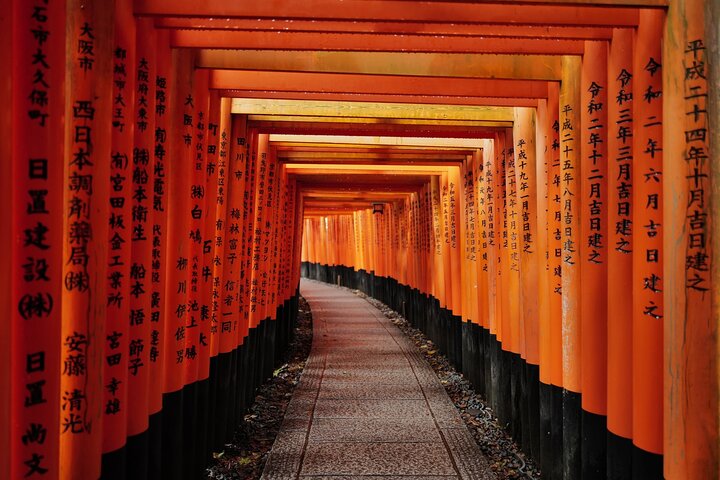
Fushimi Inari Taisha stands at 68 Fukakusa Yabunouchi-cho, Fushimi-ku, and the thing most visitors call the shrine is only its front door. The whole of Inariyama, the 233-metre mountain rising behind the main hall, is treated as shrine precinct, as the shrine states on inari.jp.
That single fact reorganises the visit. The senbon torii — the dense tunnel of vermilion gates that appears in every photograph — is the first stretch of a path that keeps climbing past sub-shrines and stone fox figures to the summit. Walking a few hundred metres and turning back is a legitimate visit; walking the full circuit is a hill climb of a couple of hours. The shrine is open ground rather than a ticketed hall, which is why no product in our sample sells entry to it, and why a guided Kyoto departure treats it as a stop rather than as a booking.
Kiyomizu-dera opens at 06:00, so nothing needs skipping
Kiyomizu-dera publishes its own hours: the gate opens at 06:00 and closes at 18:00, extended to 18:30 in July and August, with special night viewings in spring, summer and autumn accepting visitors until 21:00, per kiyomizudera.or.jp. Amulet and seal desks open around 08:00.
A 06:00 gate explains a number that looks odd at first glance. In a city packed with ticketed temples, only 1 of the 50 sampled Kyoto products carries a skip-the-line flag, and only 1 is flagged as selling out. Timed-entry systems exist where a building has a fixed capacity and a queue that cannot be dispersed. Kyoto's temples mostly sell a paper ticket at their own gate for a fixed fee, open early, and spread visitors across grounds rather than through a single door. The queue is solved by the clock, not by a reservation — which is also the argument for the €69.67 early-morning departure rated 4.95: it is buying the first two hours after the gates open.
Historic Monuments of Ancient Kyoto: 17 sites, three cities
The World Heritage property is called Historic Monuments of Ancient Kyoto (Kyoto, Uji and Otsu Cities) and was inscribed in 1994. It contains 17 component sites, and they do not all sit in Kyoto: Byodoin and Ujigami-jinja are in Uji, and Enryakuji is in Otsu, in Shiga Prefecture, according to the Japan National Tourism Organization.
The other fourteen are Kamigamo-jinja, Shimogamo-jinja, To-ji, Kiyomizu-dera, Daigo-ji, Ninna-ji, Kozan-ji, Saiho-ji, Tenryu-ji, Kinkaku-ji, Ginkaku-ji, Ryoan-ji, Nishi Hongan-ji and Nijo Castle. Two absences are worth naming. Fushimi Inari Taisha, the shrine that produces the city's most recognisable image, is not a component. Neither is the bamboo path at Arashiyama — though Tenryu-ji, thirty seconds' walk from it, is. A visitor optimising for the list and a visitor optimising for the photograph are chasing two different Kyotos, and the tea day out to Uji stays inside the same inscription.
Arashiyama: Tenryu-ji, the bamboo path and Iwatayama
Arashiyama is Kyoto's western district and one of the five the city divides itself into, alongside Central, Higashiyama, North and South. It packs three unrelated things into a walkable radius, which is why it supports a dedicated half-day rather than a stop.
Those three are Tenryu-ji, the Zen temple whose pond garden is a World Heritage component; the bamboo path immediately behind it; and Iwatayama, the hill on the far bank of the Katsura river where a colony of Japanese macaques lives at the top of a real climb. The Ultimate Kyoto Arashiyama Tour bundles all three for €57.41 across 5 hours, rated 4.97 over 1,754 reviews — the joint-best rating in our sample, at €11.48 an hour. It is the clearest case in the Kyoto catalogue of a low hourly rate and a top rating landing on the same product.
What to do in Kyoto compared: hours, hourly rate, rating
The ten most-reviewed products among the 50 we sampled, ranked by hourly rate. Prices and durations are the catalogue figures; the hourly rate is price divided by listed duration.
| Experience | Price | Duration | Hourly rate | Rating · reviews |
|---|---|---|---|---|
| Kintsugi workshop in Gion | €10.29 | 1.5 h | €6.86 | 4.92 · 1,654 |
| Gion Geisha District walking tour | €21.11 | 2 h | €10.55 | 4.87 · 2,122 |
| Gion Hidden Gems & Geisha Culture tour | €22.19 | 2 h | €11.10 | 4.95 · 3,479 |
| Arashiyama: bamboo, monkeys, gardens | €57.41 | 5 h | €11.48 | 4.97 · 1,754 |
| Kyoto & Nara with matcha in Uji | €108.10 | 8.5 h | €12.72 | 4.94 · 2,444 |
| PERFECT KYOTO 1-Day Bus Tour | €108.10 | 8 h | €13.51 | 4.92 · 16,787 |
| Early morning tour with English guide | €69.67 | 5 h | €13.93 | 4.95 · 1,970 |
| Hidden Kyoto e-biking tour | €97.02 | 3.8 h | €25.53 | 4.95 · 2,063 |
| Premium night foodie tour in Gion | €136.74 | 3.5 h | €39.07 | 4.84 · 1,871 |
| Award-winning ramen making class | €109.83 | 1.5 h | €73.22 | 4.97 · 2,590 |
- Hourly rate
- Listing price divided by listed duration. In Kyoto it ranges from €6.86 on the kintsugi workshop to €73.22 on the ramen class, a factor of ten.
- Geiko
- The Kyoto term for a professional performer of traditional dance, music and hosted conversation. Elsewhere in Japan the word is geisha.
- Maiko
- An apprentice geiko, usually a teenager, in the years of training before promotion. The Rules of the Gion-Machi District forbid photographing either.
- Senbon torii
- The corridor of vermilion gates at Fushimi Inari Taisha, donated by individuals and businesses, forming the start of the path up Inariyama.
- Inuyarai
- The curved bamboo screens along the base of Gion's wooden house fronts. The official manners map asks visitors not to touch or sit on them.

Getting around Kyoto after the bus one-day pass ended
The cheap flat-rate bus pass that older advice still recommends no longer exists. The Kyoto Municipal Transportation Bureau sold a bus-only Bus 1-Day Pass at ¥700 for adults and ¥350 for children; sales ended on 30 September 2023 and the last valid day of use was 31 March 2024, both dates published by the bureau.
What replaced it is the Subway & Bus 1-Day Pass at ¥1,100 for adults and ¥550 for children, sold year-round and covering the Karasuma and Tozai subway lines, all city buses, most Kyoto Bus routes, selected Keihan Bus routes and the flat-fare stretch of the West Japan JR Bus between Kyoto Station and Toganoo. The bureau's page for that pass was last updated on 1 April 2024 and still listed those fares when we checked on 27 August 2026. The practical consequence for a first visit: the subway is now the spine of a day pass rather than an afterthought, and a full-day guided departure removes the routing problem altogether. Live prices for every Kyoto departure sit on our Kyoto destination page.
How many Kyoto experiences fit one trip?
One long day and two short ones per three-day visit. The 8-hour departures use the day they occupy; the 1.5 to 2-hour workshops and district walks slot around temple mornings without colliding with them.
The sample supports that shape rather than the opposite one. Of the ten most-reviewed products, six run under four hours and four run five hours or more, and the long ones average the higher rating, 4.94 against 4.92. Booking early costs nothing in flexibility, because 96% of the Kyoto catalogue cancels free of charge and only 1 of the 50 sampled products is flagged as selling out — hold a seat, and drop it if the forecast for the Higashiyama hills turns. Wider options across the country start from our Japan country page.
Frequently asked questions
Is it legal to photograph geiko and maiko in Gion?
The official notice published by Kyoto City with the Gion-Machi South District Council and the Kyoto City Tourism Association states three rules for the district: no photography on private roads, no photographs of maiko, and no stopping or walking in the roadway. These are the district's published rules, displayed on signs and on the accompanying Manners MAP, which marks Shijo-dori and Hanamikoji-dori as public roads and the small lanes off them as private. The map points visitors to Gion Corner for watching performances.
Which Kyoto experience gives the most for the money?
By hourly rate, the kintsugi workshop in Gion at €10.29 for 1.5 hours, which works out at €6.86 an hour and rates 4.92. For a longer block, the Arashiyama tour at €57.41 for 5 hours is €11.48 an hour and rates 4.97 across 1,754 reviews — the joint-highest rating among the ten most-reviewed products we sampled, at close to the cheapest hourly rate in that group.
Do you need to book skip-the-line tickets for Kyoto temples?
Rarely. Only 1 of the 50 Kyoto products we sampled carries a skip-the-line flag, and only 1 is flagged as selling out. Kyoto's temples mostly sell tickets at their own gates for a fixed fee rather than through timed entry, and they open early — Kiyomizu-dera opens its gate at 06:00 and closes at 18:00, 18:30 in July and August. Arriving at opening does more than a reservation would.
Is the €108.10 full-day Kyoto bus tour worth it?
It answers a real problem: Kinkaku-ji, Kiyomizu-dera, Fushimi Inari Taisha and Arashiyama sit on opposite edges of the basin with no single line joining them. The tour rates 4.92 across 16,787 reviews, which is close to 30% of all the reviews on the 50 products we sampled, and works out at €13.51 an hour. At the identical price, the 8.5-hour Kyoto and Nara day with matcha in Uji rates 4.94 and leaves the city.
Does Kyoto still sell a one-day bus pass?
Not the bus-only one. The Kyoto Municipal Transportation Bureau ended sales of the ¥700 adult Bus 1-Day Pass on 30 September 2023, and the last day it could be used was 31 March 2024. The Subway & Bus 1-Day Pass remains on sale year-round at ¥1,100 for adults and ¥550 for children, covering the Karasuma and Tozai subway lines plus city and selected private bus routes.
How many World Heritage sites are there in Kyoto?
The property Historic Monuments of Ancient Kyoto (Kyoto, Uji and Otsu Cities) was inscribed in 1994 and comprises 17 component sites, but they are not all inside Kyoto: Byodoin and Ujigami-jinja stand in Uji, and Enryakuji in Otsu, in Shiga Prefecture. Fushimi Inari Taisha, the city's most photographed shrine, is not among the 17; Tenryu-ji at Arashiyama is.
