
Honolulu is the capital of the state of Hawaii and the seat of its only city government — 350,964 people on 177.2 km² at 21.30°N, 157.86°W, about 1,981 people per km². It occupies the southern shore of Oʻahu, and the visitor's version of it is five districts: Downtown, Waikīkī, Manoa-Makiki, and the eastern and western reaches out towards Hawaiʻi Kai and Pearl Harbor. The catalogue we track lists 523 bookable experiences under the city name, at a median of €102, from €30.78 to €518.87, with 94,268 reviews behind the 50 products we sample.
That catalogue has a peculiarity worth knowing before you book anything. A large part of it is not about Honolulu at all. It is island inventory filed under the capital because the capital is where the coach picks you up — and the part that genuinely happens inside the city concentrates on two places, one of them a war grave.
Is the Honolulu catalogue actually about Honolulu?
Only partly. Reading the 50 sampled products by what their own titles say, 29 name a site inside Honolulu, 15 name a site outside it, and 6 name no location at all. The 15 that leave the city are the ones people buy: they hold 51,834 of the 94,268 reviews — 55.0%, against 34,202 (36.3%) for the 29 urban ones.
The outbound 15 are recognisable at a glance: full circle-island loops, the Dole Plantation shuttle to Haleʻiwa, ziplines, the Polynesian Cultural Center at Lāʻie, catamarans out of Ko Olina. One of them is not even on this island. The most expensive product filed under Honolulu is a 12-hour, €518.87 day trip to Hawaiʻi Volcanoes National Park, which sits on Hawaiʻi Island and requires two flights to reach. The city name on that listing describes where you are staying, not where you are going.
Read the title, not the heading. A listing filed under Honolulu tells you where the shuttle collects you. Where the day actually happens is stated inside the product title — and in 15 of the 50 cases the answer is outside the city.
Pearl Harbor: 15 of the 50 products in the city list
Pearl Harbor is what makes this a city catalogue rather than a duplicate of the island one. 15 of the 50 sampled products name Pearl Harbor, the USS Arizona or the USS Missouri — 30% of the inventory — carrying 14,184 reviews, 15.0% of the destination total.
The pricing inside that single site is unusually wide. Those 15 products run from €37.60 to €338.59, a 9.0× spread around a €131.04 median, for what is legally the same free-admission destination. Four of them cost under €50: those are coach seats with narration. The upper end buys a private vehicle, the Battleship Missouri across the channel on Ford Island, or a full-day pass combining several sites.
The ratings behave differently too. The 15 Pearl Harbor products average 4.555, against 4.718 for the other 35, and not one of them reaches the catalogue's upper band. Scarcity follows the same line: all three products flagged as likely to sell out are Pearl Harbor tours, and 0 of the 50 carry a skip-the-line flag, because there is no line to skip and no ticket to resell.
The USS Arizona is a war grave: what the Park Service asks
Pearl Harbor National Memorial is administered by the National Park Service and commemorates the attack of 7 December 1941. The USS Arizona was destroyed at her mooring and never raised. In the Park Service's own wording, she "is the final resting place for many of the ship's 1,177 crewmen who lost their lives on December 7, 1941". The white memorial spans the hull without touching it.
The access rules are the Park Service's, not an operator's. Entry to the memorial and visitor center is free, including museums and grounds; the USS Arizona Memorial programme is reserved through Recreation.gov, which charges a US$1 non-refundable management fee per ticket. The visitor center opens 7am to 5pm daily, closed Thanksgiving, Christmas and New Year's Day; the first programme starts at 8am and the last boat leaves at 3:30pm. Parking is US$7 per day. Details at nps.gov/perl. None of the €37.60 to €338.59 charged by the tours is admission: it buys transport, a guide and, at the upper end, the neighbouring museum ships, which are separately run and do charge.
One rule catches almost every visitor: bags are not permitted in the memorial or the visitor center, backpacks, purses and camera bags included, and a storage facility near the entrance charges a small fee. The Park Service states that reservations are strongly recommended and that standby tickets are limited. We could not confirm from the official pages we checked how far in advance tickets are released or at what hour, so treat any release schedule you read elsewhere as unverified and check Recreation.gov directly for your dates.
Waikīkī: a district and a label that mean different things
Waikīkī is a beachfront district of Honolulu, roughly two kilometres of shoreline along Kalākaua Avenue beneath the tuff cone of Lēʻahi. In the catalogue it is also a marketing word, and the two uses do not overlap.
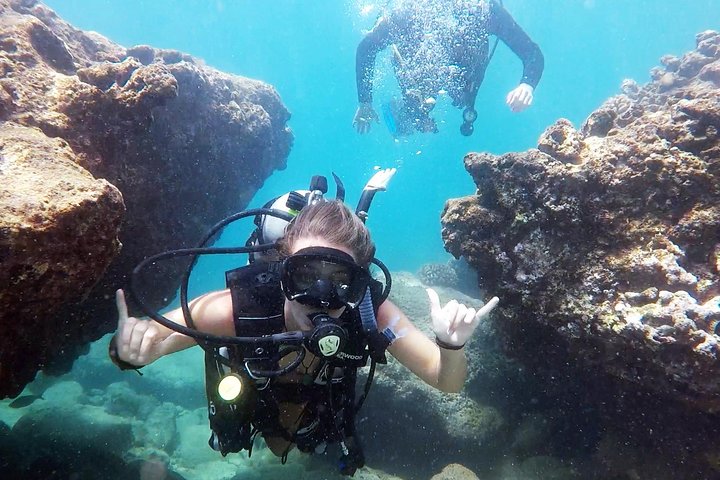
Waikīkī appears in 20 of the 50 product titles. In 12 of them it is a pickup point — "from Waikīkī", "Waikīkī shuttle", "Waikīkī pickup" — and in only 8 is it the place the activity happens. Those eight are the district's real inventory: catamaran sails, a turtle snorkel run offshore, a beginner scuba dive, a luau on a hotel lawn, a resident Cirque du Soleil show, and a stage magic show at a beachfront hotel.
So a search for "Waikīkī" returns mostly products that merely start there. What the district itself offers free — the public beach, the surf break that made it famous, the walk to the Kapiʻolani Park end — appears in no catalogue at all.
Honolulu's booking page is two catalogues wearing one name: a city list built on a memorial and a beach, and an island list that happens to leave from the same hotel lobby.
Iracema Melo, on reading the Honolulu catalogue
Book by the city or by the island? What each list holds
Book by the island if you want variety, by the city if you want Pearl Harbor. 23 of the 50 products here also appear in the Oʻahu catalogue — 46% duplication — so for nearly half the inventory the choice changes nothing. It is the other half that decides.
Of the 27 products unique to the Honolulu list, 11 are Pearl Harbor tours, against just four Pearl Harbor products in the entire Oʻahu catalogue. The city page is where that site's depth lives. What it lacks is everything the island sells beyond it: parasailing over Waikīkī — two products holding 9,247 reviews on the island list and absent from the city one, despite happening in Honolulu waters — plus three North Shore shark dives with 5,787 reviews, three submarine and glass-bottom boat trips with 6,078 reviews, the Kualoa Ranch UTV runs, and the eight-line North Shore zipline.
If your list includes the North Shore, Hanauma Bay reservations or the windward coast, start from our guide to what the Oʻahu catalogue sells, which covers the circle-island format and the two government reservation systems in detail. Live prices for the island sit on the Oʻahu destination page; the city's own inventory is on the Honolulu destination page.
ʻIolani Palace and how Honolulu became the capital
Downtown holds the one site that explains why the city exists in its present form. Honolulu became the capital of the Kingdom of Hawaiʻi in 1845, when Kamehameha III moved the seat of government here from Lahaina; the harbour that gave the place its name had already made it the kingdom's commercial centre.
ʻIolani Palace was built for King Kalākaua: its cornerstone was laid on 31 December 1879 and construction finished in 1882. The Kingdom of Hawaiʻi was overthrown in 1893 by a group calling itself the Committee of Safety, backed by United States forces. Queen Liliʻuokalani, who had succeeded her brother in 1891, was deposed and later imprisoned in the palace. The islands were annexed by the United States in 1898.
After 1893 the palace became the headquarters of the Provisional Government, then the capitol of the Republic, the Territory and the State of Hawaiʻi, a role it held until 1969. It is a registered National Historic Landmark and operates as a museum; hours and tour formats are published at iolanipalace.org. No product in the 50 we sample is a palace tour.
Lūʻau in Honolulu: six products, and a wide rating gap
A lūʻau is a Hawaiian feast, named for the taro leaf dish served at it and tied historically to specific occasions. The commercial evening version pairs a fixed-price buffet with a staged performance of hula and other Pacific dances, and should be read as a ticketed show rather than a private gathering.
Six of the 50 products are luaus, priced €88.82 to €128.00 — a tight band around the €102 median. Their ratings are not tight at all: they run from 3.71 to 4.81, a 1.10-point spread, the widest of any group in this catalogue. Two are inside the city, on the Hilton Hawaiian Village lawn and at the Aloha Tower waterfront downtown; the rest run from venues elsewhere on Oʻahu, including Ko Olina on the leeward coast.
Where a category's prices agree and its ratings do not, the variable is the production rather than the format, so rating and review count carry more weight here than anywhere else in the list.
- Honolulu
- Hawaiian for "sheltered bay", after the natural harbour that made the site the kingdom's commercial port and then its capital in 1845.
- Waikīkī
- "Spouting fresh water", for the springs and streams that once fed the wetlands and taro fields behind the beach, drained in the early twentieth century.
- Mauka and makai
- Directions used in daily speech and on road signs across the city: mauka is inland, towards the mountains; makai is towards the sea.
- Lei
- A garland worn or given to mark arrival, achievement or respect. Giving one is a social act with meaning attached, not a greeting service.
- Aliʻi
- The hereditary ruling class of the Hawaiian Kingdom. ʻIolani Palace, Kalākaua Avenue and Kapiʻolani Park all carry aliʻi names.
Honolulu experiences compared: price, hours, rating
Prices, durations and ratings below are the figures we track today for the ten most-reviewed products filed under Honolulu. The location column marks whether the product stays inside the city.
| Experience | Where | Price | Time | Rating |
|---|---|---|---|---|
| Grand circle island tour, full or half day | Island | €87.95 | 6.5 h | 4.97 · 19,227 reviews |
| Grand tour around the island with snorkelling | Island | €78.61 | 8 h | 4.84 · 10,723 reviews |
| Circle island tour with Waimea Falls and Byodo-In | Island | €163.92 | 9 h | 4.94 · 8,133 reviews |
| Circle island snorkelling: Dole, Pali Lookout | Island | €98.59 | 10 h | 4.60 · 6,066 reviews |
| Pearl Harbor and USS Arizona Memorial from Waikīkī | City | €48.37 | 4 h | 4.49 · 6,037 reviews |
| Mauka Warriors Luau | Unstated | €128.00 | 4 h | 4.79 · 3,659 reviews |
| Beginner scuba diving off Honolulu | City | €68.88 | 1.5 h | 4.91 · 3,555 reviews |
| Magic show at a Waikīkī beachfront hotel | City | €87.07 | 2 h | 4.94 · 3,461 reviews |
| Grand circle island experience from Waikīkī | Island | €74.71 | 10 h | 4.83 · 2,729 reviews |
| USS Arizona Memorial and Battleship Missouri | City | €131.04 | 6 h | 4.59 · 2,723 reviews |

Getting from Waikīkī to Pearl Harbor and downtown
TheBus, run by Oahu Transit Services for the City and County of Honolulu, covers the city and the island, Pearl Harbor and Hanauma Bay included, and takes the HOLO stored-value card. Skyline, the elevated rail that opened in 2023, runs on the western side and serves commuters rather than the visitor corridor.
The distances are short — Pearl Harbor sits about 15 km west of Waikīkī, downtown roughly half that — which is why the cheap end of the group exists: a €37.60 seat covers ground a city bus also covers, and pays for timing and narration instead. Parking in Waikīkī is expensive, which is why every one of the ten most-reviewed products includes transport. Wider routes across the country start from our United States destination coverage.
Frequently asked questions
Should I book Honolulu experiences or Oʻahu experiences?
Both lists overlap by 46% — 23 of the 50 products we sample appear in each. Book from the Honolulu list for Pearl Harbor, where 11 of the city's 27 exclusive products sit against four on the island list. Book from the Oʻahu list for the North Shore, shark dives, submarines and parasailing, none of which appear under the city name.
How much does it cost to visit Pearl Harbor?
Nothing to enter. The National Park Service states there is no entrance fee for Pearl Harbor National Memorial or its visitor center, museums and grounds. Booking a USS Arizona Memorial programme ticket through Recreation.gov carries a US$1 non-refundable management fee, and parking is US$7 per day. The €37.60 to €338.59 charged by tours in our sample buys transport, guiding and museum-ship entry.
Can I take a bag to the USS Arizona Memorial?
No. The Park Service states bags are not permitted within the memorial or visitor center, including backpacks, purses and camera bags, and that a bag storage facility near the entrance charges a small fee. Plan to arrive carrying only what fits in a pocket.
How much do Honolulu tours cost?
The median is €102, with prices from €30.78 to €518.87 — a 16.9× spread. The cheapest product is a shuttle to the Dole Plantation and the most expensive a 12-hour day trip to Hawaiʻi Volcanoes National Park on another island. Median duration is four hours, and 98% of the catalogue cancels free of charge.
What is there to do inside Honolulu itself?
Twenty-nine of the 50 products name a site inside the city: Pearl Harbor and its museum ships, the water off Waikīkī, downtown and the harbour, Hanauma Bay on the eastern edge, and the resident shows. ʻIolani Palace and the beach itself are not sold as products.
Do Honolulu experiences need booking in advance?
Not to skip queues — 0 of the 50 products carry a skip-the-line flag. Book early because capacity is finite: the three products flagged as likely to sell out are all Pearl Harbor tours, and USS Arizona Memorial programme tickets are reserved separately through Recreation.gov, where the Park Service says standby is limited. Since 98% cancels free of charge, holding dates costs nothing.


